

How Much Water Should You Drink a Day? Men, Women & Litres
Posted by eWater.com on Oct 3rd 2026
Eight glasses a day is the rule most of us grew up with. It is easy to remember, but it is not what the health authorities actually say. The real answer depends on whether you are a man or a woman, how big you are, how active you are, and how hot it is outside. This guide gives you the official numbers in cups, ounces and litres, a simple rule of thumb you can work out in your head, the signs you are running low, and why the water itself matters as much as the amount.
How Much Water Should You Drink a Day?
The most quoted figures come from the US National Academies of Sciences, Engineering, and Medicine. Its report on water intake found that adequately hydrated adults take in about:
- Men: about 15.5 cups a day (3.7 litres, or 125 ounces)
- Women: about 11.5 cups a day (2.7 litres, or 91 ounces)
There is an important catch. Those numbers are total water, which includes the water in your food. The same report says about 20 percent of our water comes from food, like fruit, vegetables and soup, and the other 80 percent comes from drinks.
So from drinks alone, that works out to roughly 12 to 13 cups a day for men and roughly 9 cups a day for women.
How Much Water Should You Drink a Day in Litres?
If you think in litres, here is the same guidance converted. One cup is about a quarter of a litre, and one litre is about 34 ounces.
- Men, total water: 3.7 litres, about 3 litres from drinks
- Women, total water: 2.7 litres, about 2.2 litres from drinks
- Pregnancy, total water: 3 litres
- Breastfeeding, total water: 3.8 litres
A standard half-litre bottle is a handy yardstick. Most women are looking at four to five of them through the day from drinks, and most men at around six.
Water Intake Calculator: A Simple Rule of Thumb
The official figures are averages. A small, quiet person and a large, active one will not need the same amount. That is why so many people search for a water intake calculator based on body weight.
eWater founder Fred Van Liew has used a simple guideline with clients for decades: one quart of purified water per fifty pounds of body weight. A quart is four cups, a little under one litre. This is a rule of thumb, not an official guideline, but it is easy to work out:
- 100 pounds: 2 quarts (about 8 cups, or just under 2 litres)
- 150 pounds: 3 quarts (about 12 cups, or just under 3 litres)
- 200 pounds: 4 quarts (about 16 cups, or just under 4 litres)
To use it, divide your weight in pounds by fifty. That is how many quarts to spread through your day. Drink a little more when you exercise, sweat, or spend time in the heat. If you have a heart, kidney or liver condition, or your doctor has told you to limit fluids, follow your doctor's advice instead.
How Much Water Should a Woman Drink?
For most healthy women, the National Academies figure is about 11.5 cups, or 2.7 litres, of total water a day. That is roughly 9 cups from drinks once food is counted.
Needs go up at two points in life:
- Pregnancy: about 3 litres of total water a day, or roughly 13 cups
- Breastfeeding: about 3.8 litres of total water a day, or roughly 16 cups, since breast milk is mostly water
Activity, heat and body size matter for women just as they do for men, so the body-weight rule above is a useful personal check. If you are pregnant or nursing, ask your doctor or midwife what is right for you.
What Changes How Much Water You Need
- Exercise. Any activity that makes you sweat means more water, before, during and after.
- Hot or humid weather. You lose more through your skin, even sitting still.
- High altitude. Faster breathing in thin, dry air uses more water.
- Illness. Fever, vomiting and diarrhea all drain fluids quickly.
- Coffee, soda and alcohol. They count as fluid, but many people lean on them instead of water. Plain water is still the best base.
Signs You Are Not Drinking Enough Water
Your body is good at telling you. Common signs of dehydration include:
- Thirst and a dry mouth
- Dark yellow urine, or going less often than usual
- Tiredness or low energy
- Headache
- Feeling dizzy or lightheaded
- Dry skin and lips
The simplest check is the color of your urine. Pale yellow usually means you are drinking enough. Darker than that is a cue to drink more. Confusion, fainting, a racing heart or very little urine for many hours need medical care right away.
It is also possible to drink too much. Forcing down large amounts in a short time can dilute the salt in your blood. Spread your water through the day rather than drinking it all at once.
Why the Water You Drink Matters Too
Most guides stop at how much. Fred Van Liew's view is that what you drink matters just as much. "Hydration is always the first and most important part of any health or health restoration program," he writes. And his instruction for the water itself is specific: "You must always start with purified water, then revitalize and harmonize it."
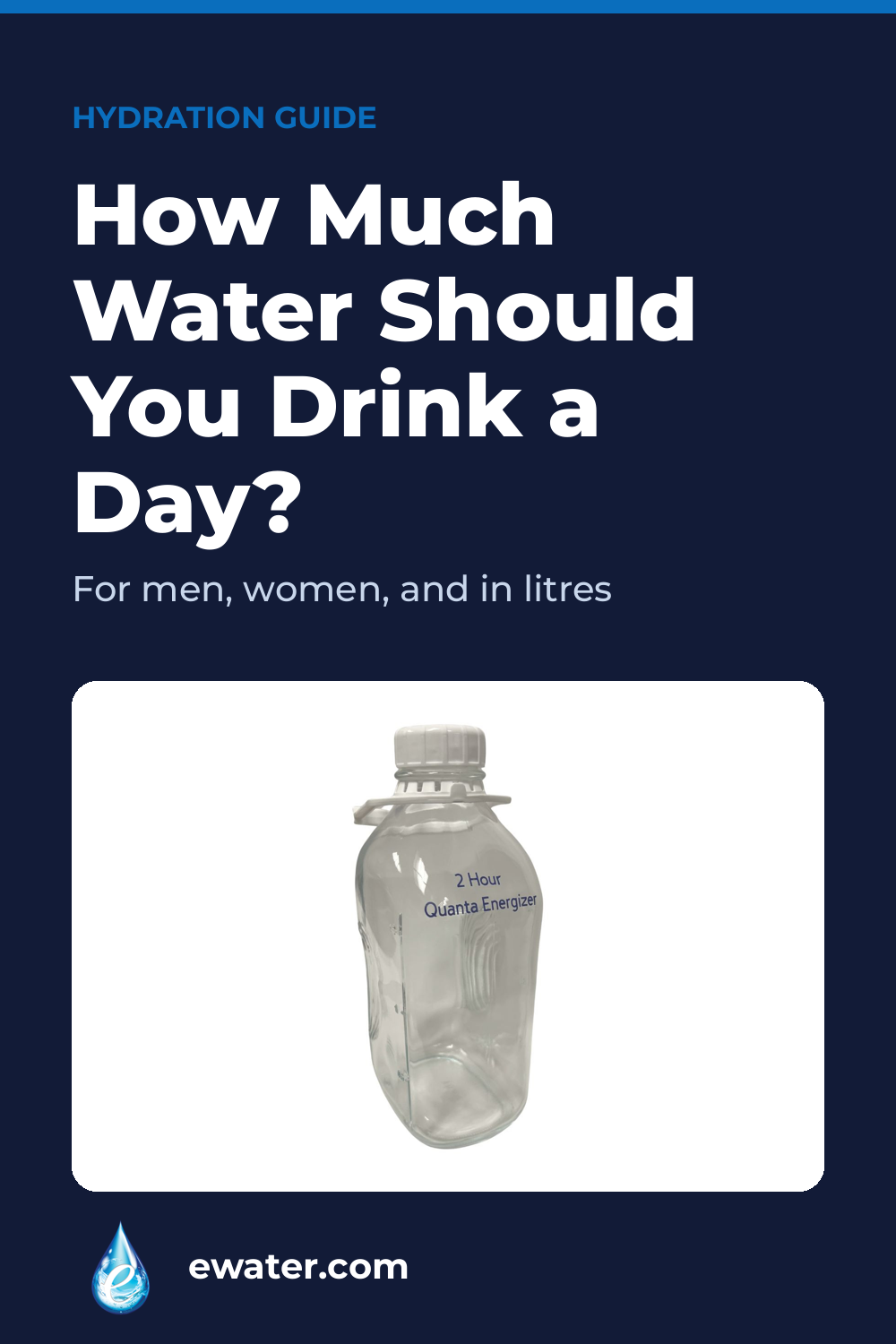
That means starting with clean water, such as reverse osmosis or distilled, then bringing it back to life before you drink it. The Travel Quanta Water Jug is made for exactly that. You fill it with any purified water, and it makes Quanta water you can drink just as you would your normal purified water, with no timer needed.
It seals securely and has a sturdy carry handle, so it goes from the kitchen to the car to the office. You can use the same water for tea, coffee and cooking. And because it is a one-time investment that keeps working for years, it takes the place of buying bottle after bottle.
Easy Ways to Drink More Water
- Start the day with a full glass before coffee.
- Keep water where you can see it, on your desk, in the car, by the bed.
- Sip steadily through the day instead of catching up at night.
- Have a glass with every meal.
- Eat more water-rich foods, like cucumber, watermelon, oranges and soup.
Frequently Asked Questions
How much water should you drink a day?
The National Academies puts it at about 15.5 cups (3.7 litres) of total water a day for men and about 11.5 cups (2.7 litres) for women, with about 20 percent of that coming from food. Needs rise with exercise, heat, illness, pregnancy and breastfeeding.
Is 8 glasses of water a day enough?
Eight 8-ounce glasses is about 2 litres. For many women that is close to what they need from drinks. Most men, and anyone active or in the heat, will need more.
How do I calculate how much water I need?
A simple rule of thumb from Fred Van Liew is one quart of purified water per fifty pounds of body weight. Divide your weight in pounds by fifty to get quarts per day, then adjust for activity and heat. It is a guideline, not medical advice.
How much water should a woman drink a day?
About 11.5 cups (2.7 litres) of total water, or roughly 9 cups from drinks. During pregnancy that rises to about 3 litres, and while breastfeeding to about 3.8 litres.
What is the best water to drink?
Fred Van Liew's guidance is to start with purified water, such as reverse osmosis or distilled, and then revitalize it. The Travel Quanta Water Jug lets you make that water at home or on the go.